ecological consciousness:
leads us to universal love
places us among the living around us
helps us feel earth’s life forms
Ecological consciousness is a way of being on Earth that begins with our primordial experience of living things. When we live our lives in an ecological way, we feel the cry of the living carried by all beings in pain. We are connected to this world, not some distant, conceptual world. Destruction of the environment, of the lives of other beings, is no longer possible.
This consciousness is a stepping stone towards integrated non-dual awareness, and I believe, is slowly becoming more and more integrated in the lives of people across the planet.
This is the topic of a research project I undertook from 2023-2026, which is still being refined as reflection deepens on the subject.
How does ecological consciousness manifest itself?
It is intangible: you can’t touch it, bring it to you, or share it through the life of another person.
Feeling, intuition, deep connection, emotion, wonder and the discovery of other textures, colours and faces of living things are an integral part of the experience of this consciousness.
There are no systematic beliefs or thoughts behind this ecological consciousness. There are no morals with rules to follow. Only the practices and wisdom shared by nature, to be put into practice in your own life, to live ecological awareness.
In my experience, there are four aspects to ecological consciousness that need to be present for a profound experience of nature: flow, presence, connection, and reality as perceived through lived experience.
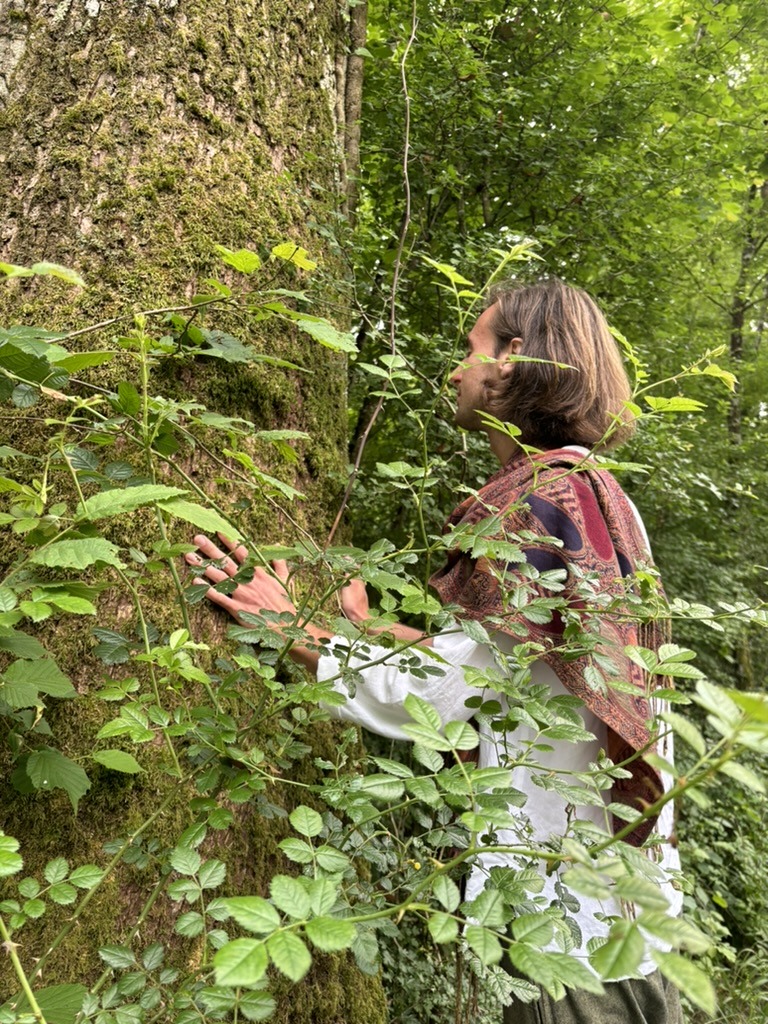
FLOW
Movement or rhythm is the natural state of living beings on Earth. There is always a back-and-forth, a dialectic, between things: between what exists, and what has just been born; between our needs and desires, and those of other people and beings; between life and death. Stasis, walls, fighting and rigid movement are manifestations of a lack of flow, which is a completely human approach to viewing the world.
Nature doesn’t work in a linear way, nor with stops and starts. Movement is cyclical, dialectical, with all the parts in constant interaction with each other.
When we experience flow, and not resistance, stasis or linearity, we enter a state of consciousness, an ecological way of being. Because we have discovered how nature works.
PRESENCE
Being grounded, relaxed and aware is central to presence. We Westerners spend a lot of time in our heads, where the body, the environment, and connections to others are excluded from our experience.
Presence is a profound bodily experience. The future and the past exist at the same time as the now, all three condensed into a temporality other than the linearity of the everyday world. To be in presence, we slow down our breathing, which becomes deep. The body relaxes, the support of the Earth is felt, and the organic bodily rhythm is rediscovered.
In the mental world, it’s easy to get caught up in thoughts. Presence requires us to slow down and unidentify with the thoughts that come to us. In this way, we will be able to open up to the natural world, and our intuition will open up to receive the world in a different way.
CONNECTION
In a deep connection, we are not isolated, and we don’t have a sense of ego. The individual and the importance of the ego remain at the back of a shared experience, where the worlds of several beings intermingle, making a world in common.
Connection is a deep bond with the other, which enables us to feel compassion and empathy, and create a shared world together. Connection is part of ecological awareness because it links us with others through presence and movement. We are beings of relationship, and it is in relationship that we create meaning, cultures and knowledge. The isolated individual is a fabrication of modernity, and is felt by many people. But this isolation is not the organic state of the human being.
LIVED EXPERIENCE
Very often in the West we use mental concepts to conceive of our world. This leads us to a world devoid of feeling, emotion, intuition and bodily experience on Earth. Nature is not a concept, something we can grab hold of, but everything we are, and everything that surrounds us.
This reality is material, and also immaterial; tangible and intangible. When we have an experience of ecological consciousness, we are connecting to this Earth, and not to an earth or a concept of reality that is ideal, imagined, or far removed from our daily experience. There is no room for romanticising nature; the reality we live in is difficult, but also very beautiful. Changing our perspective and our way of life on Earth is not easy. With the practices and wisdom of nature, it is possible that we will all be able to reconnect with ourselves, with others, and with the world around us.
Changing our perspective and our way of life on Earth is not easy. With the practices and wisdom of nature, it is possible that we will all be able to reconnect with ourselves, with others, and with the world around us.