Sometimes the concept of kundalini can be difficult to understand, especially when we come from different world views with different metaphysical assumptions, concepts, and even worlds.
In this contemporary society, we are often not living in the same ‘world’ as our neighbours or fellow citizens, because the concepts, reference points, and accepted ‘reality’ is so different.
Traditions are not the same, and should not be reduced to each other to make simplistic comparisons for rhetoric benefits. It might sound good to say that kundalini is the same as mauri – but this isn’t the case, because they sit in very different contexts. Imagine viewing a teapot from behind and from the side: the one looking behind will not see the spout, and emphasise the roundness of the teapot; the one looking at the side will see both the spout and the handle, and emphasise these protruding aspects of the form. We all describe the same base form of reality, but what we see and how we experience it is different.
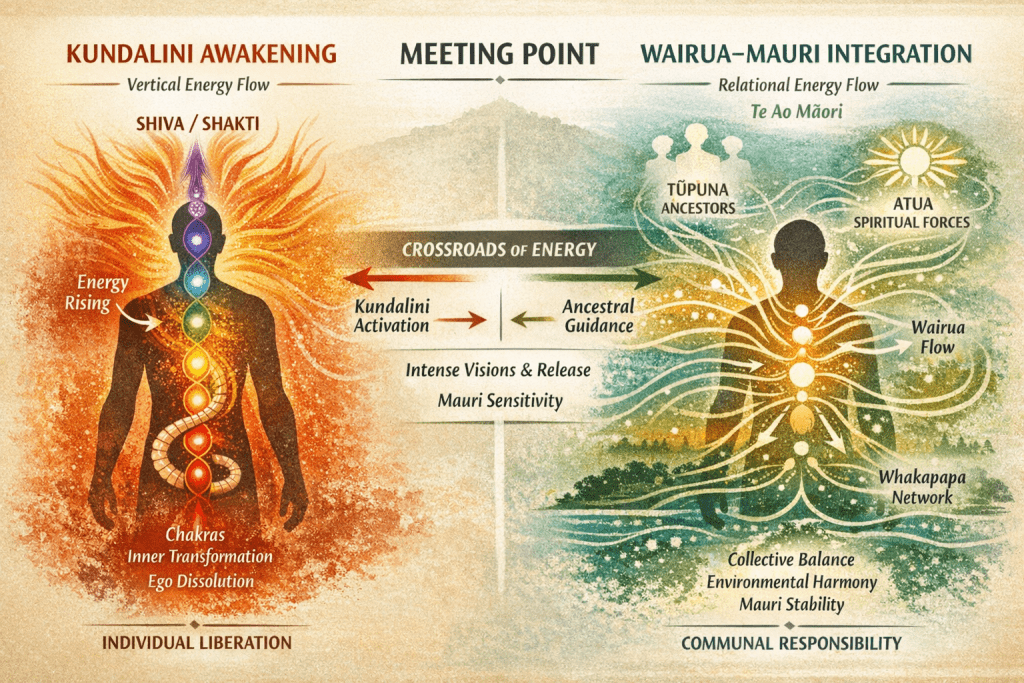
Image: The different paths of kundalini and mauri, and their respective contexts.
What is Kundalini?
In the non-dual traditions of Kashmir Shaivism, Kundalini is seen as the flux of life itself. In human beings, this energy sits at the base of the spine and is responsible for the evolution of consciousness in each being. It sits, dormant, waiting to be activated such that it may move up through the energetic channels of the body, and awaken higher consciousness in that being.
According to Swami Muktananda, “It is that supreme energy which moves and animates all creatures, from the elephant to the tiniest ant.” Kundalini is present in all living things, as the life force that drives and motivates action within these beings. It is also the sexual, reproductive energy to be found in all living beings.
In a kundalini awakening experience, and on the spiritual pathway in general, kundalini is the force behind the dissolution of the ego, disrupting the sense of ‘I’ and can feel like a burning or purging of different attachments that we may have. This awakening is sparked through practice, but also through a lineage-based transmission called shaktipat. Kundalini is seeking transmutation – the transformation and evolution of consciousness in a person. Kundalini awakening is a experiential and somatic process, occurring in the body with real felt and lived experiences. It leads a person towards liberation of the self, the transcending of the individual and separate condition which humans are seen to take, upon birth into this world.
What is Mauri?
In te ao Māori, the Māori world-view, mauri is the intrinsic life force contained within all beings – people and animals, but also forests, rivers, and stones. Maori Marsden refers to the concept of mauri as follows: “all the created order partook of mauri (life force and ethos) by which all things cohere in nature” and “in human beings this essence was of a higher order and was called mauriora (life principle).”
Mauri is a life-binding spark, it hold the body and the spirit (wairua) together, and searches for the greatest cohesion within the relationships in which one lives. These are not just human relationships, but geneaological relationships between people and their environment. A person’s mauri can be strengthened, damaged or restored. Mauri lives through people and beings, passed on from generation to generation.
For Māori, those with special abilities are often called matākite. These people have extra-sensory perception, and are capable of perceiving between the different realms of this reality, understanding the geneaological interconnectedness of life. Matākite generally do not experience rising energy like with kundalini, rather they are focused on seeing clearly. They see what is already alive within the relational field of consciousness, and this comes through visions, dreams, communication with spirits, and greater sensitivity.
Ka oho te wairua, ka matāra te tinana, he aroha ki te aroha,
ka kā te māramatanga
When your spirit awakens, when your body is alive, when love is unconditional, enlightenment flows.
The following proverb is translated using the term enlightenment, the same state as kundalini tantra. This enlightenment is a kind of insight, understanding, or clear vision – akin to the concept of realisation of one’s true nature.

Understanding these terms in their relative contexts
In tantric pathways, kundalini leads to the realisation of one’s true nature as a liberated being, as consciousness itself. For Māori, the matākite is one who also perceives reality as it is – the relationships present between all beings, which must be in right order and harmony.
The role of mauri in humans is one that leads to right perception, right relation, in order to serve the human and more-than-human communities. If mauri is unbalanced, then illness occurs. Kundalini, however, leads to individual liberation, transcending one’s individual identity, and the realisation of the non-dual nature of reality. At the heart of reality, both systems recognise the underlying unity of this reality. Kundalini enlightenment is the realisation of non-duality – that there is no separation, whereas māramatanga is about perceiving the relational nature of reality.
The gifts of matākite are recognised within the tantric traditions as “siddhis”: powers that arise with the activation and rising of kundalini energy. These powers are however seen as potential obstacles on the path, as we should not attach to these new capabilities, but rather allow their manifestation to arise as a mere witness.
For someone rooted in te ao Māori, kundalini awakening can be seen as changes in wairua, mauri, and collective relationships, balancing out things that are not in harmony to achieve greater harmony.
Visions are seen as messages from tūpuna, or ancestors. Vibrations in the body are seen as changes in the flow of someone’s mauri. Emotional releases are about rebalancing relationships. The whole experience is seen to take place in the relational field, and not in the individual, interior plane of energy.
Both tantric systems and te ao Māori emphasise the importance of what Māori refer to as tikanga – the correct spiritual practice appropriate to particular experiences and situations. Yogic paths are led by gurus, initiated into the lineage, and tikanga emphasises the role of a tohunga, also rooted in lineage, to guide this process. This is important so as not to misinterpret visions, perform wrong practices, or become ungrounded and unstable.
Environmental alignment and strengthening the mauri are two key responses within the framework of te ao Māori towards a kundalini awakening experience. This aligns well with kundalini guidance given by Siddha gurus in the tantric traditions: connecting with the land, eating in a proper manner, purifying the body and mind, and performing practices such as yoga asanas all help in regulating the flow of kundalini shakti.
The frameworks of Kundalini Tantra and te ao Māori can therefore understand each other, even if the forces and their ultimate goals are different. Guidance from Siddha yoga gurus for those who have different perspectives can be shared through indigenous world views, taking care to not simplify concepts, and to protect the sacredness of the journey in all cases.
Ultimately, the experience will speak for itself, and all those who undergo spiritual transformation learn the framework that best fits.
Really interesting angle on Mauri through the kundalini lens – that connection between energetic activation and indigenous understanding of life force resonates with me. I’ve been experimenting with Quantress for a few months now, and the way it profiles your archetype to generate personalized frequency work seems to bridge that science-meets-spirituality gap you’re exploring here. Have you found any overlap between traditional Maori energy practices and modern bioacoustic optimization?